
A payment may seem affordable when compared with average monthly income and still create difficulties on a particular date. The reason is simple: money does not enter or leave an account evenly. Income may arrive on specific days, bills may be grouped at the start of the month, or there may be annual renewals and predictable expenses that do not appear in a basic monthly budget.
The three-calendar test is a practical method for reviewing this reality before accepting a loan, deferred payment, purchase financing arrangement, or any commitment with due dates. It does not determine whether an option is suitable for a particular person, but it helps frame a more useful question than “does the payment fit in my budget?”: “will there be available funds when it is due?” To apply it, simply gather dates and amounts and review several consecutive months.
What the three-calendar test is
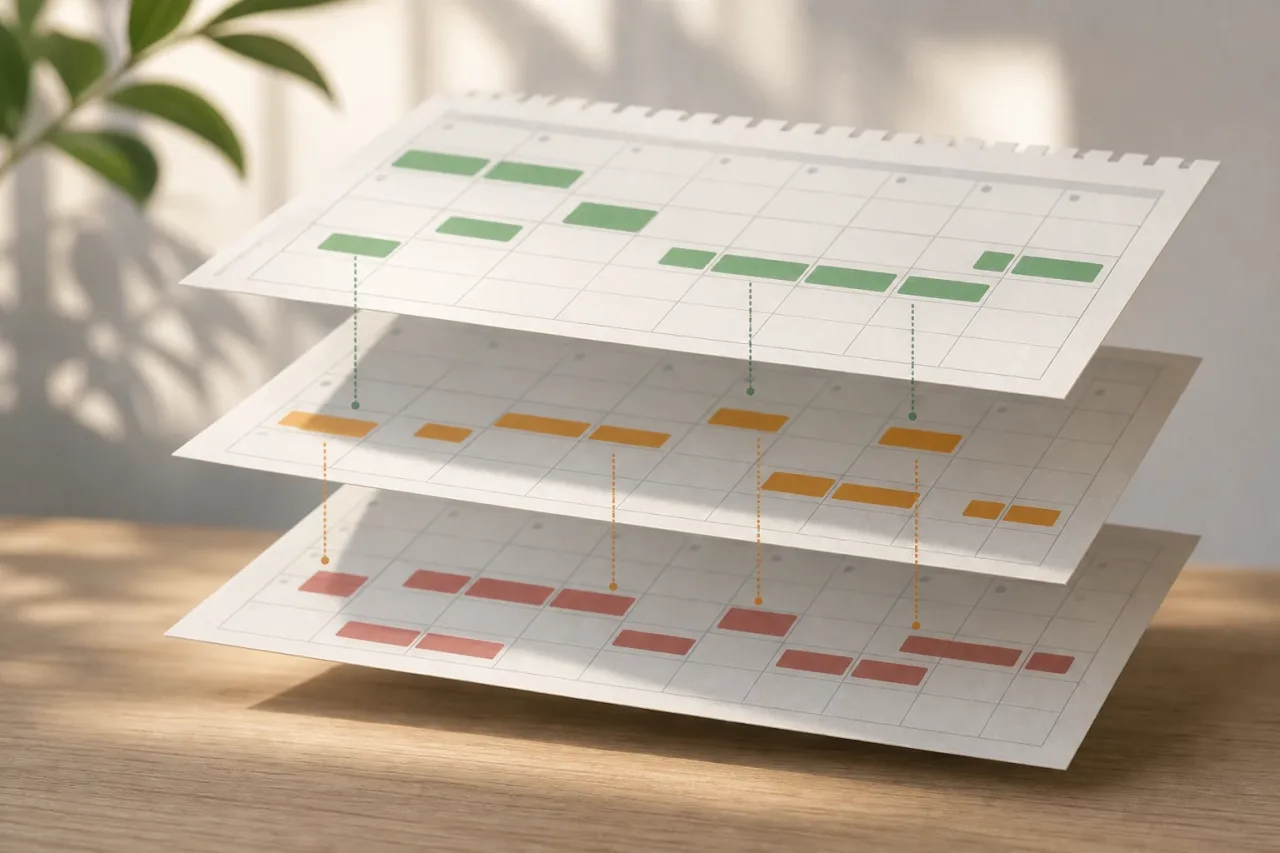
The test consists of creating and overlaying three records: one for income that is actually available, one for personal and household expenses, and one for financial obligations. Viewing them together helps identify concentrations of payments and periods when the balance may become very tight.
It is important to carry out the analysis by date or, at least, by week. A monthly total can hide a timing mismatch. For example, a person may be paid at the end of the month and have several bills due at the beginning of the next one. If they do not retain part of the previous payment, an instalment due early in the month may coincide with a period of low liquidity, even if the overall monthly result appears positive.
It is advisable to review between six and twelve months, or a period that includes known non-monthly expenses. If income is variable, it may be useful to prepare more than one scenario: a typical one, a cautious one with lower receipts, and another that accounts for reasonable payment delays.
Calendar 1: available income, not just expected income
The first calendar records the money expected to be received and the date on which it will be available. List salaries, pensions, invoices already issued with a known collection date, recurring returns, or other regular income. The key is to distinguish between confirmed income and possible income.
- Record the estimated date the money will be credited, not just the month to which the income relates.
- Record the net amount available for expenses and obligations.
- Separate stable income from variable, one-off, or unconfirmed income.
- If there is a payment concentrated at a particular time of year, mark it as exceptional and avoid mentally spreading it across all months.
- Include, where applicable, balances already set aside for a specific purpose, but do not count them twice as freely available money.
For self-employed people, those who earn commissions, or those with seasonal activity, caution is especially relevant. A sales forecast or an invoice sent does not necessarily equal cash that is available. Basing a fixed due date on an uncertain receipt increases the risk of having to cover it with savings intended for another need, an overdraft, or new financing.
Calendar 2: fixed expenses and predictable outgoings
The second calendar brings together cash outflows that are not financial debts: housing, utilities, insurance, transport, food, education, communications, care, and other regular expenses. In addition to monthly payments, include those that arise quarterly, semi-annually, or annually.
Non-monthly expenses are often what causes a calculation based only on averages to fail. An insurance renewal, a reasonably foreseeable repair, tuition fees, or a tax may not occur every month, but they affect the balance when they arrive. There is no need to predict every unexpected expense; the aim is to record what is known and leave room for the unknown.
How to record irregular expenses without distorting the calendar
If you know the date and approximate amount of an annual payment, place it in the relevant month. If the amount varies, use a cautious estimate and label it as such. You can also show a regular provision if you actually set it aside. What should be avoided is assuming that an annual expense no longer exists because it does not appear in the current month.
Also include everyday expenses that may increase at certain times, such as travel, celebrations, returning to routine, or healthcare needs. There is no need to turn the exercise into a perfect forecast: its value lies in showing the months and weeks with the greatest foreseeable burden.
Calendar 3: instalments, due dates, and deferred payments
The third calendar groups together all current financial obligations and the new payment being considered. Add loans, credit cards with deferred payment arrangements, instalment purchases, lines of credit, advances, required minimum payments, and any other due date that requires funds on a specific date.
- State the amount, due date, and collection method for each obligation.
- Distinguish between a mandatory payment and a voluntary or early payment.
- Note whether the due date can be changed and under what conditions, without assuming that it will be possible.
- Consider any known associated charges, if applicable, and not just the main payment.
- Check whether several payments are charged automatically on the same days.
A new payment should not be analysed in isolation. A small amount may coincide with other obligations and become a significant burden on that day. Conversely, changing a payment date could ease a concentration of payments, but it does not in itself reduce the total cost or remove the need to have sufficient room.
How to overlay the three calendars in a simple table
No complex tool is needed. You can use a spreadsheet, diary, or paper table. Create columns for the date or week, confirmed income, variable income, essential expenses, predictable non-monthly expenses, current debts, proposed new payment, and estimated cumulative balance.
Start each period with the actual available balance, not with a card limit or money you expect to receive. Add only income that will arrive before each date and subtract payments due up to that point. The result is not intended to predict every penny, but to show when the buffer becomes narrow.
The central question is not whether average income exceeds average payments, but whether the balance retains room before and after each due date.
Use simple markers to flag weeks requiring attention: several accumulated bills, reliance on an unconfirmed receipt, a low balance after essential expenses, or a new payment coinciding with an annual renewal. This visual approach makes it easier to spot patterns that a summarised monthly figure may hide.
What to look for when reviewing the payment and expense calendar
When looking at the payment and expense calendar, first look for the lowest balance points. A month may end with a positive result yet include days when there is barely any money left for food, transport, or other basic needs. It is also worth observing how much the plan depends on there being no changes.
- Weeks when rent, utilities, insurance, and payments are concentrated.
- Due dates that fall before the usual payment date.
- Months with recurring expenses that are not covered by a real provision.
- Payments that only fit if variable or exceptional income arrives.
- A frequent need to use credit to cover everyday expenses.
- No room for small everyday unexpected expenses.
These signs do not require a single conclusion, but they do justify pausing and reviewing the decision. A budget that works only in the most favourable scenario may be fragile in the face of a delayed payment, a slightly higher bill, or an unplanned necessary expense.
Hypothetical example: the average is not always enough
Imagine a person with regular monthly income and a new payment that, when viewed in the monthly total, appears to leave a remainder. However, the income is credited towards the end of the month. In the first few days, housing costs, two utility bills, an existing payment, and a planned annual payment are charged. The new payment would also be due at the beginning of the month.
In the monthly average, income exceeds outgoings. In the weekly calendar, however, the first week requires a substantial amount to be available before the next payment arrives. If that provision does not exist or is intended for another expense, the payment does not fit well on that date, even if its amount in isolation seems moderate. The issue is not only how much is paid, but when it is paid.
Testing alternatives and keeping a safety margin
If tight months appear, a lower payment may reduce the pressure, but it does not always resolve the mismatch. A longer term, for example, may change the payment schedule and the total cost. The amount financed may also be lower, the purchase may be postponed, or there may be a non-credit alternative, such as saving beforehand, adjusting spending, or negotiating payment directly with the provider where possible.
The test should be repeated for any alternative, without assuming that a low monthly payment automatically means a manageable commitment. Review the due date, number of payments, other obligations, and the room that would remain after covering essentials.
Leaving a safety margin does not mean forecasting an exact figure for every unexpected event. It means not taking the calendar to its limit. A margin can help absorb differences in amounts, delayed income, or unavoidable everyday expenses without relying on new credit. If the plan works only when everything happens exactly as expected, it deserves a cautious review.
Final checklist before accepting a new due date

- I have recorded income by its actual availability date.
- I have separated confirmed receipts from variable or uncertain income.
- I have included monthly expenses and predictable recurring payments.
- I have gathered all existing financial payments and due dates.
- I have reviewed several months, including those with higher spending.
- I have checked the estimated balance before each payment date.
- I have tested a cautious scenario, not just the usual average.
- I retain room after essential expenses and obligations.
- I have compared alternatives without focusing only on the monthly payment.
- If there is pressure on any date, I have considered postponing or reconsidering the commitment.
The three-calendar test does not replace reading the terms of a contract or fully reviewing the cost and consequences of a payment. It does provide a useful check: visualising whether due dates fit the actual rhythm of income and expenses. Before taking on a new payment, looking at the dates can be as important as looking at the amount.
Sources and resources
- Financial literacy — OECD
- Consumer credit information — European Commission
- Financial education portal — Banco de España & CNMV