
The monthly payment is easy to see, but it does not always explain whether financing fits the value a purchase will continue to provide. An item may seem affordable because its payment is spread over a long period and yet be inefficient if it stops working, becomes obsolete, or is barely used before it is paid off.
The cost per use of a financed purchase suggests looking at the decision from another perspective: relating all the money the item is likely to require to the months or uses it can provide. It is not a formula for making the decision on its own, nor does it replace reviewing your ability to make payments, but it can reveal mismatches between the debt term, useful life, and expected actual use.
What cost per use measures and the questions it helps answer
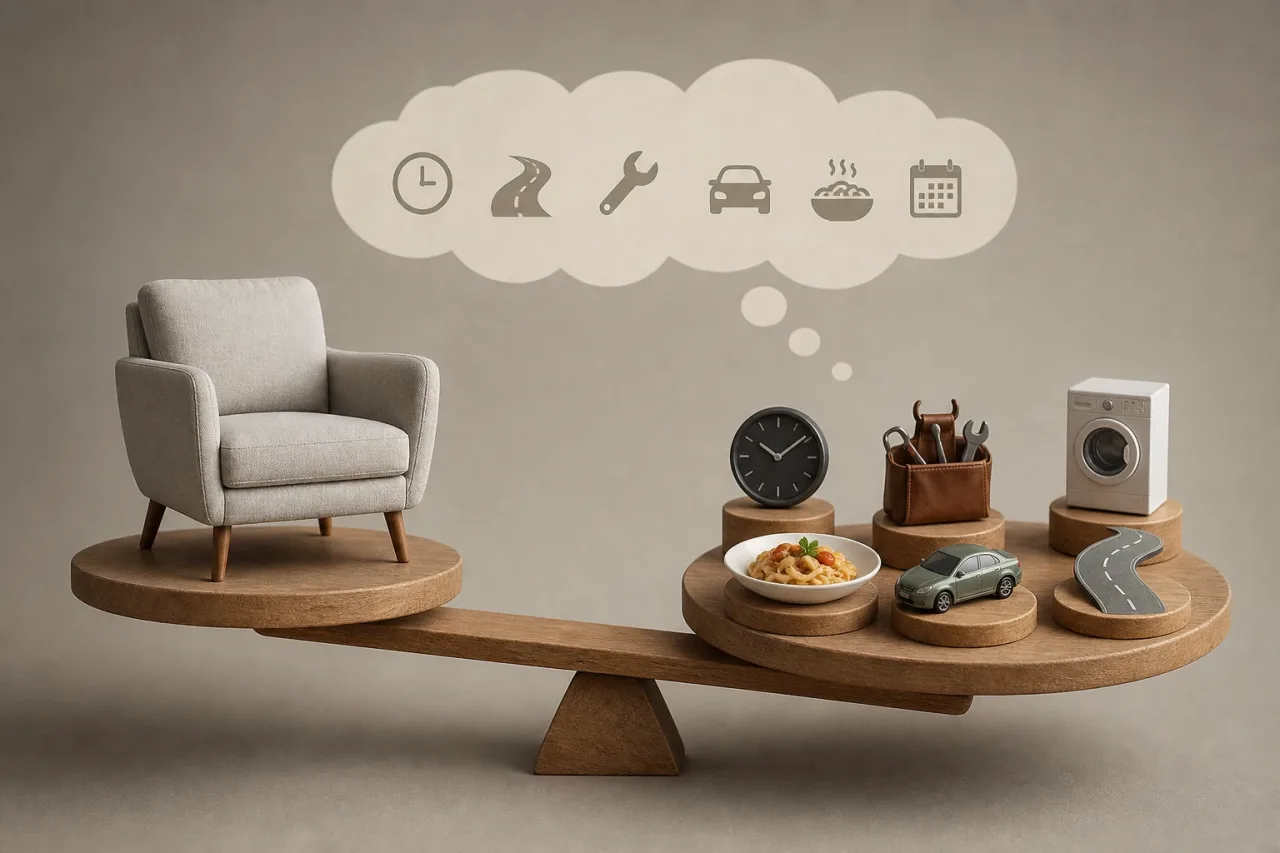
Measuring a purchase by its cost per use means dividing its estimated total cost by a unit of usefulness. That unit may be a month of use, an hour, a trip, an avoided repair, a meal prepared, or any reasonable measure depending on the product.
This approach is especially useful for technology, vehicles, appliances, household equipment, furniture, or renovations. Instead of asking only, “Can I afford the monthly payment?”, it encourages you to consider complementary questions:
- How much will I actually pay, including interest and foreseeable expenses?
- How long will the item continue to be useful to me?
- How often do I expect to use it?
- Will the loan continue after the product needs to be replaced or requires a significant repair?
- Could an initially more expensive option last longer or require fewer expenses?
The answer does not necessarily always favor the cheapest product. A lower initial price may make sense if it meets a temporary need. On the other hand, if use will be frequent and ongoing, durability, ease of repair, and maintenance costs may carry considerable weight.
Information to gather before doing the calculations
The calculation will be an estimate, because useful life and future use are not known with certainty. Even so, starting with complete information prevents the monthly payment or advertised price from hiding part of the cost. It is helpful to separate the following elements:
- Cash price: this serves as a reference to identify the price of the item without financing.
- Down payment or initial payment: this is money allocated to the purchase even if it is not part of the installments.
- Amount financed and total cost of credit: review the total shown in the documentation, not just the amount received or the number of installments.
- Term: state how many months the payment obligation will remain in place.
- Related expenses: delivery, installation, essential accessories, or taxes, if they are not included in the displayed price.
- Ownership costs: maintenance, consumables, insurance, energy, inspections, foreseeable repairs, and, where applicable, storage.
- Useful life in your situation: this is not only how long it can technically last, but how long it will be useful given your needs, compatibility, and available space.
- Expected use: the approximate number of months, hours, trips, or uses during that useful life.
When comparing alternatives, use the same criteria. For example, do not include insurance for one option and omit it for another if both require it. It is also helpful to distinguish expenses necessary to use the item from optional extras, since combining them can make comparison more difficult.
Two estimated calculations: per useful month and per expected use
The first calculation provides a time-based view:
Cost per useful month = estimated total cost of ownership ÷ expected months of usefulness
The estimated total cost of ownership may include the down payment, all expected installments, known fees, and use or maintenance expenses that can reasonably be expected during the period analyzed. If a future repair is highly uncertain, it can be noted separately or included in a cautious scenario rather than treated as a certain amount.
The second calculation focuses on intensity of use:
Cost per use = estimated total cost of ownership ÷ number of expected uses
A “use” should be defined consistently. For a bicycle, it could be a trip; for a tool, a workday; for a kitchen appliance, one preparation. If it is not meaningful to count uses, operating hours or months of usefulness are usually clearer measures.
These results are not the same as the monthly expense that will come out of your bank account. A product may cost little per useful month and still have a monthly payment that is too high for the available budget. That is why it is worth evaluating both: the flow of payments during financing and the cost spread across the expected usefulness.
The duration test: comparing debt, usefulness, and obsolescence
A basic check is to place the credit term and the item’s estimated useful life on the same timeline. If you expect to use a device for two years but the financing extends well beyond that, there is a risk that you will still be paying when the product no longer meets the original need.
This does not mean every loan must end before the useful life does. Some items may retain value, be resold, or continue working for many years. However, debt that is longer than the expected usefulness deserves additional review, especially for products subject to rapid wear, frequent technological changes, or a history of intensive use.
Duration should also take practical obsolescence into account. An item may turn on and work but stop being useful because of a lack of compatibility, updates, parts, technical service, or sufficient features. Estimating a cautious useful life, rather than the maximum possible one, helps avoid basing financing on the most favorable scenario.
Expenses that do not appear in the monthly payment
The monthly payment usually reflects the loan, not necessarily the cost of owning and using the item. Leaving out recurring expenses can make a purchase appear cheaper than it will be. Depending on the situation, it is worth considering:
- periodic maintenance and inspections;
- consumables, replacement parts, and necessary accessories;
- insurance or paid warranties, when required or relevant;
- foreseeable repairs after a certain level of use;
- installation, delivery, subscriptions, or energy;
- replacement cost if expected durability is low.
You do not need to guess every amount. It is preferable to identify known expenses, document assumptions, and acknowledge what cannot be estimated. If a cost is mandatory to use the product, excluding it from the calculation reduces the value of the comparison.
Hypothetical case: two options with different costs and durations
Suppose there are two pieces of equipment that serve a similar function. Option A has a total financing cost of 690 monetary units and requires an additional 90 units in expected consumables and maintenance. Its estimated total cost is 780. It is expected to be useful for 36 months and used about 180 times. The estimated result would be 21.67 units per useful month and 4.33 per use.
Option B requires a total financing cost of 880 monetary units and expected expenses of about 40, bringing its estimated total cost to 920. If it is expected to be useful for 60 months and used 300 times, the cost would be 15.33 units per useful month and 3.07 per use.
The second alternative costs more in absolute terms, but it provides a lower cost per unit of usefulness under these assumptions. That does not automatically make it the best choice: you would need to confirm that its monthly payments are affordable, that the estimated duration is realistic, and that the additional features will be used. The comparison only shows how conclusions change when time and use are included.
How to account for uncertainty and the method’s limitations
To avoid relying on a single forecast, you can calculate three scenarios: high use, likely use, and low use. In the low-use scenario, reduce the number of uses or months of usefulness and allow for a shorter useful life if there is a plausible reason. If the cost per use rises sharply with a moderate reduction in use, the purchase may be sensitive to changes in your habits.
This approach has limitations. An urgent need, an item shared by several people, or a purchase linked to safety, accessibility, or work may be difficult to summarize in one figure. It also does not fully measure convenience, time saved, or satisfaction from use. In these cases, the calculation works best as a reference for organizing information, not as a rigid rule.
Final questions before committing

- What will the total amount paid be if all expected installments are made?
- What necessary expenses are outside the financing?
- How long is it reasonable to expect the item to remain useful?
- Will I still be paying when I will probably need to replace it?
- What happens to the cost per use if I use it less than expected?
- Have I compared alternatives by total cost, duration, and use, as well as by monthly payment?
- Can I make the payments without relying on uncertain income or neglecting other commitments?
Calculating cost per use does not eliminate uncertainty, but it helps turn a decision based only on a monthly payment into a more complete assessment. By connecting financing, ownership expenses, term, and expected usefulness, it becomes easier to spot when a debt could outlast the purchase’s practical value.
Sources and resources
- Financial literacy — OECD
- Consumer credit information — European Commission
- Financial education portal — Banco de España & CNMV