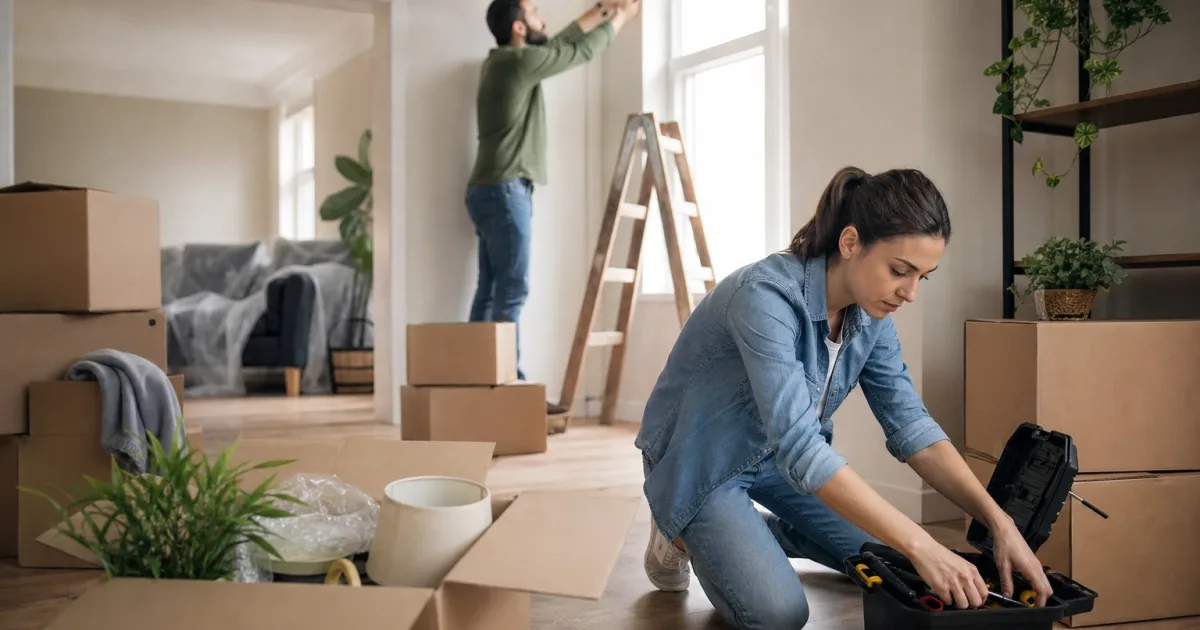
Buying a home does not end when you sign the deed or receive the keys. From that point on, a stage with its own expenses begins: making the property livable, moving in, activating services, and absorbing the first unexpected issues. A post-purchase home budget helps estimate this need for cash without confusing it with the down payment, taxes, or expenses associated with the purchase transaction.
Preparing it does not mean you have to buy everything immediately or that every need must be financed. Its purpose is to organize priorities, set aside a reasonable buffer, and make decisions with a more complete view of the real cost of moving in.
What is a move-in budget?

A move-in budget is the forecast of money needed for the home to be used normally during the first few months after purchase. It includes both one-off outlays and initial recurring payments, as well as a reserve for unexpected issues related to moving in.
It is not the same as the mortgage down payment or the costs of formalizing the transaction. Those items arise before or at the time of closing. The move-in budget starts to become important when you take possession of the home, although it is advisable to calculate it before committing all your savings to the purchase.
It is also different from a full renovation. Some homes may need significant work before you move in, but in many cases the initial expenses are more modest: a move, a plumbing repair, basic lighting, curtains, or essential appliances. The key is not to assume that the amount available after closing will be enough without making a specific list.
The three spending stages
Separating expenses by timing helps avoid duplication and shows how much needs to be available at each stage.
Before closing
This stage typically includes the deposit, down payment, taxes, and applicable costs related to the purchase transaction. Appraisal, administrative, or other processing costs may also arise depending on the transaction. Although they do not belong to the move-in stage, they determine how much savings will remain for it.
When you take possession of the home
These are the expenses that allow you to move in and live safely with minimum conditions. They may include moving belongings, setting up utilities or changing account holders, key copies, initial cleaning, small repairs, and essential equipment. If the home is delivered empty, it is worth distinguishing between what is needed from day one and what can wait.
During the first few months
After that come payments that may not be apparent when viewing the property: the first electricity, water, gas, or telecommunications bills; homeowners' association fees; home insurance; maintenance; and replacement of small items. At the same time, the mortgage payment begins and the household's usual commitments continue. That is why the calculation should not be limited to the week of the move.
Classify each expense by priority
A simple classification reduces the risk of treating every purchase as urgent. It can be done using three groups.
- Essential for living there: actions related to safety, health, or basic operation. For example, fixing an active leak, checking an installation with an obvious risk, having secure access, minimum lighting, a place to sleep, and food storage.
- Necessary but deferrable: useful items that do not prevent you from living in the home for a period of time. This may include completing the furnishing, renovating a room that is functional, or replacing an old item that has not failed immediately.
- Optional improvements: aesthetic, layout, or comfort changes driven by personal preferences. They are no less legitimate, but it is advisable to budget for them separately so they do not reduce the buffer allocated to real needs.
This division can be reviewed if circumstances change. An expense that was initially deferrable may become a priority if it affects safety or causes greater damage. The difference is not whether something is desirable, but the consequences of not acting now.
Items worth checking before using all your savings
The list varies depending on the condition of the home and whether it is purchased furnished, but some items are worth reviewing explicitly.
- Moving and cleaning: transportation, packing, temporary storage if needed, and deep cleaning before moving in.
- Utilities: the status of contracts, changes of account holder, possible new connections, inspections, and first bills. It is advisable to confirm which services are active and under what conditions.
- Basic furniture and equipment: a bed, a way to cook, a refrigerator if there is none, and a table or workspace when needed. An inventory helps avoid impulse purchases or buying duplicate items.
- Small repairs: faucets, shutters, outlets, locks, seals, or paint. Requesting an estimate when you cannot calculate the cost helps prevent assigning an arbitrary figure.
- Homeowners' association and home: regular fees, approved or anticipated special assessments that may have been identified, and amounts that are still pending clarification before closing the transaction.
- Insurance and reserves: the premium or installment payments for the insurance you take out, and a buffer for unexpected issues. A reserve is not leftover money: its purpose is to prevent a minor breakdown from disrupting the entire budget.
Urgent repair, maintenance, or improvement: how to tell them apart
An urgent repair usually requires prompt action when it compromises people's safety, livability, or may allow the damage to spread. An active leak, an electrical issue that presents a risk, or being unable to close the home properly are examples that justify a prompt professional inspection.
Necessary maintenance prevents deterioration, even if it can perhaps be scheduled. Painting a worn surface, renewing seals, or adjusting a door may require attention, but not always on the same day. By contrast, replacing a finish you dislike, changing a functional kitchen for a more up-to-date one, or installing decorative elements usually falls within the area of improvement.
Before deciding, it is useful to ask: can I live here safely over the next few months? What damage will waiting cause? Is there a safe temporary solution? What is the cost of not taking action? If there is doubt about an installation, having it checked by a qualified professional is preferable to assuming it is merely an aesthetic detail.
How to create your move-in budget
- Make an inventory of the home. Go through each room and note what is there, what works, and what is missing to use it. Keep available photographs, documents, and reports.
- Assign a priority and a date. Mark each item as immediate, needed in the first few months, or optional. State when it is due or when you expect to pay it.
- Estimate amounts using verifiable information. Use estimates, previous bills when available, or prices from several providers. If a cost is uncertain, note it as your own range and avoid presenting it as final.
- Separate one-time payments from monthly expenses. A one-off repair should not be mixed with recurring payments. This distinction shows how much cash you need at the start and how much your monthly spending will increase.
- Add a reserve. Set an amount that is not allocated to planned purchases. The home may reveal needs that were not visible during the viewing.
- Review the result after closing. Update the list with the actual bills and remove anything that is no longer needed. The budget is a living tool, not a fixed figure.
Coordinate it with your mortgage payment and monthly buffer
The loan payment becomes part of the household's obligations alongside utilities, homeowners' association fees, insurance, food, transportation, and other existing payments. Therefore, in addition to the initial cash, it is advisable to calculate a scenario for the first few months with complete monthly income and expenses.
The goal is not to achieve impossible perfection, but to check that moving in does not force you to choose between essential payments. If the plan leaves very limited cash on hand, it may be prudent to postpone improvements, seek lower-cost alternatives, or review the purchasing schedule. Keeping the emergency fund separate from the money set aside for a sofa, an aesthetic renovation, or non-urgent equipment provides clarity.
Be cautious about financing the move-in with short-term credit
A personal loan, a credit card, or deferred payment may seem like a quick solution for furniture or repairs. However, they add a payment and financing cost at a time when the mortgage is also being added. In addition, small purchases financed separately can make it harder to track total spending.
Before turning to credit, it is advisable to identify whether the need is truly immediate, compare the total cost, and verify how the monthly payment would affect the budget. Postponing an optional improvement may preserve more buffer than turning it into a fixed obligation. When it is a safety repair, obtaining several estimates and knowing the available alternatives helps you decide with better information.
A hypothetical case and final questions

Imagine someone who gathers the money needed for the down payment and closing, and retains a limited amount after the transaction. When they receive the keys, they discover they need to repair a shutter, change a lock, hire movers, and buy some basic items. No individual expense seems decisive, but when added to the first mortgage payment, utilities, and homeowners' association fees, their buffer narrows. The purchase may have been viable at closing, but the lack of a move-in budget reduces their ability to respond to an unexpected issue.
Before committing all available savings, it may be useful to check:
- What money will remain after all purchase transaction payments?
- What does the home need to be safe and functional from day one?
- What expenses will arise during the first three months?
- Which purchases can wait without affecting livability?
- What reserve will remain available if an unexpected issue arises?
- How do these amounts fit with the mortgage payment and the rest of the monthly payments?
Answering these questions does not eliminate uncertainty, but it allows the purchase to be assessed from the perspective of post-purchase liquidity as well. Planning your arrival in the home is an essential part of preparing a sustainable purchase.
Sources and resources
- Mortgage information and guidance — Banco de España
- Consumer credit information — European Commission
- Financial education portal — Banco de España & CNMV