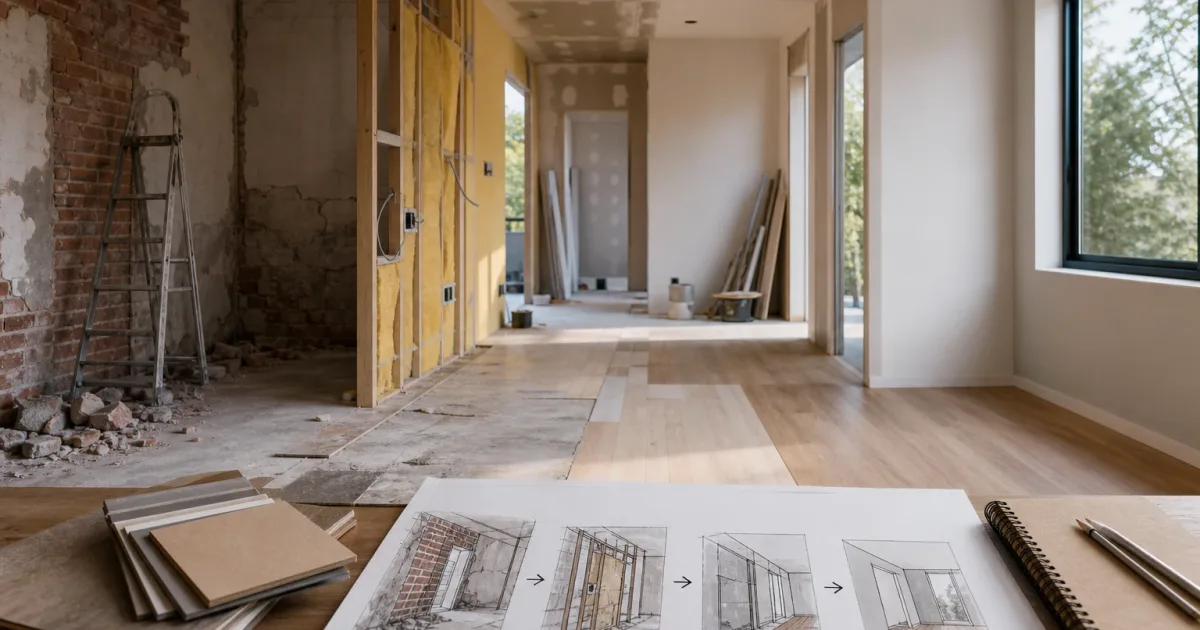
A home renovation is often presented as a total estimate, but it rarely behaves like a fixed purchase with no changes. Decisions may arise regarding materials, work hidden after demolition, delivery times, or adjustments needed to coordinate different trades. Therefore, financing a renovation in stages can be a more orderly way to manage the project: it allows you to decide what is done first, when it is paid for, and what amount should remain available for unforeseen events.
The goal is not only to gather enough money. It also involves preventing committed payments, including deposits and instalments on potential financing, from getting ahead of the work actually completed. Good planning separates the expected cost, reserved funds, contracts with suppliers, and monthly repayment capacity.
Why a renovation should not be treated as a single purchase

The initial amount for a renovation is an estimate based on a specific scope: which rooms will be worked on, which materials will be used, which installations will be altered, and which work is excluded. If any of these elements changes, the cost and schedule may also change. Treating the entire project as a single payment can make it difficult to identify cost overruns until a significant portion of the budget has already been committed.
Dividing the work does not mean splitting it up arbitrarily. It means identifying work packages that have an observable outcome and a logical dependency. For example, it is generally not prudent to begin decorative finishes before checking the condition of installations that will be concealed. Each stage should provide useful, verifiable progress that is consistent with the overall plan.
In addition, a staged approach leaves room to review decisions. After completing an essential phase, the homeowner can confirm whether to maintain the scope of subsequent stages, adjust the finishes, or postpone improvements that are not urgent. This flexibility is especially relevant when considering the use of savings, deferred payments, or a loan.
Separating work by priority and dependency
A practical starting point is to classify items into three groups. The first includes work that is essential for the safety, habitability, or proper functioning of the home. The second includes important improvements that could be completed later without preventing the basic use of the property. The third contains finishes, aesthetic elements, or extras that are best decided once the actual progress of earlier stages is known.
- Essential phase: necessary repairs, installations, waterproofing, structural work, or actions linked to permits and technical requirements.
- Functional phase: layout changes, kitchen, bathroom, finishes, or solutions that improve the use of the home.
- Finishing phase: decorative lighting, non-essential furniture, aesthetic improvements, or additional equipment.
The classification should respect technical dependencies. Postponing an item that requires another one to be redone later can increase the overall cost. For this reason, it is advisable to ask for the estimate to describe what each stage includes, what preparatory work it requires, and which elements must be completed before proceeding.
Creating a useful budget for each stage
A staged budget should be more detailed than a single overall figure. For each stage, it is advisable to distinguish between materials, labour, applicable permits or fees, waste management, ancillary equipment, and any necessary external service. It is also reasonable to include a contingency reserve, separate from the expected cost and not confused with money available to expand the project.
The reserve does not eliminate the risk of cost overruns, but it avoids assuming that any difference will automatically have to be covered with more debt. Its amount depends on the uncertainty of the work and on each household's financial situation. In projects involving non-visible elements or technical solutions that still need to be confirmed, the need for a buffer may be greater than in a clearly defined project.
It is also useful to include a review buffer between stages. This is not an item to spend without control, but rather a decision point: before moving on to the next stage, compare the actual accumulated cost with the budget, update the remaining reserve, and check whether the schedule remains feasible.
A scheduled payment should not replace verifying that the agreed progress has occurred.
Defining verifiable milestones before making payments or drawing funds
Milestones are specific outcomes that make it possible to link a disbursement to progress. They should be clearly described before signing, applying for financing, or accepting a payment schedule. Expressions such as “work well advanced” or “first part completed” may lead to different interpretations. It is preferable to link each payment to identifiable work, delivered documentation, or materials actually received, where applicable.
A milestone may be the completion of planned demolition, the installation and testing of part of the plumbing, the delivery of specified materials, or the completion of finishing work in a particular room. The method of verification will depend on the type of project. In complex projects, it may be appropriate to have the work reviewed by an independent technical professional.
- Define the scope of the stage and its exclusions.
- Establish what evidence or check will confirm its completion.
- Agree on the amount, estimated date, and payment method.
- Review the progress before authorising the next disbursement.
- Keep estimates, invoices, approved changes, and proof of payment.
Deposits may be necessary, for example, to reserve materials or begin work. However, it is advisable to understand what they cover, whether they are proportionate to the stage, and what conditions apply if there are delays, changes, or non-compliance. A high deposit does not in itself amount to construction progress.
Coordinating savings, supplier payments, and a potential loan
The renovation schedule must fit the financial schedule. If a loan is used, you need to consider not only the amount received, but also the instalments, term, total cost stated in the contractual information, and when repayment will begin. Instalments may coincide with outstanding invoices, regular household expenses, or a temporary reduction in income. Therefore, financing that appears sufficient to pay for the renovation may not be comfortable to manage month by month.
One planning option is to allocate reserved savings to priority stages or to the contingency fund, and to consider financing only for a defined part of the project. There is no universally suitable allocation. Before increasing the financed amount, it is advisable to assess whether the new expense addresses an essential need, whether it can be postponed, or whether it would require reducing the reserve to an imprudently low level.
The sequence of fund drawdowns and payments also matters. Drawing all the money at the outset may make management easier, but it could generate instalments or costs before each amount is needed, depending on the product taken out. On the other hand, delaying a drawdown should not leave an already committed stage without funds. Reading the terms, including possible requirements, fees, and repayment options, helps compare alternatives without relying only on the monthly instalment.
How to respond to scope changes and cost overruns
A deviation does not necessarily require continuing with the original plan or immediately financing the difference. When an unexpected cost arises, the first step is to request a specific explanation and an updated estimate that separates the additional work from what was already contracted. It is then advisable to review the effect on the stage cost, the estimated total, the reserve, and future payments.
Common alternatives include temporarily pausing a non-critical item, reprioritising work, reducing finishes, or reviewing the technical project. If expanding debt is being considered, it is reasonable to compare the new monthly commitment with the household budget and other foreseeable expenses. Increasing the loan to keep all the extras can turn a construction decision into a longer-lasting financial burden.
Warning signs that suggest stopping and reviewing
- Deposits representing a large share of the total without a clear justification or materials having been delivered.
- Payments requested before the agreed milestone or without a way to verify progress.
- Verbal changes that alter price, materials, or timelines without an updated estimate.
- Invoices with insufficient detail to link amounts to specific items.
- Using the reserve for optional improvements before essential work is complete.
- Financing decisions made urgently to cover delays or unreviewed changes.
These signs do not by themselves prove that there is a problem, but they justify seeking clarification, documenting agreements, and not authorising further payments until the financial scope is understood.
Hypothetical case: three stages and a cost overrun
Imagine a renovation divided into installations, kitchen renovation, and finishes. The household sets aside an amount for unforeseen events and plans to cover part of the cost with savings and another part with financing. After the first stage, an additional intervention is found to be necessary in one installation. The new amount reduces the available reserve and may alter the payments for the second stage.
Instead of automatically adding that amount to the loan, the homeowner could request details of the work, verify its necessity, update the cumulative budget, and review the options. They may keep the second stage but postpone certain finishes. Or they may reduce the scope of the kitchen to preserve a minimum reserve. If they decide to finance an additional amount, they should calculate how the instalment and total cost change under the terms offered, without assuming that a lower instalment means a lower final cost.
Questions before committing to each stage

- What exact work is included, and what is excluded?
- What milestone will demonstrate that the stage is complete?
- What portion is paid in advance, and what portion is paid after progress is verified?
- What reserve will remain available after this disbursement?
- What will happen if the cost, timeline, or materials change?
- Does the financing instalment, if any, still fit with regular expenses?
- Is it possible to postpone or reduce an improvement without affecting safety or functionality?
Planning a renovation in stages does not guarantee that unforeseen events will not arise, but it makes it easier to make decisions using up-to-date information. Linking each disbursement to verifiable progress, maintaining a separate reserve, and reviewing the scope before increasing debt help ensure that the financial pace follows the actual pace of the work.
Sources and resources
- Loans and credit for bank customers — Banco de España
- Consumer credit information — European Commission
- Financial education portal — Banco de España & CNMV